
 ADELM
ADELM
1.2. Shortwave Radiation
Incoming solar radiation \(R_{\mathrm{sw}}^\downarrow =\)
swdown_Wm2 is partitioned among vegetation, ground, and the
atmosphere. ADELM separates shortwave radiation into visible /
photosynthetically active radiation (PAR) and near-infrared (NIR), and
solves a two-stream radiative-transfer problem that accounts for direct
beam transmission, diffuse scattering, and canopy-ground multiple
interactions (Fig. 1.2.1). The main objective is to diagnose the net absorbed shortwave radiation by vegetation and by ground. These net fluxes satisfy the shortwave conservation relation:
Here, \(R_{\mathrm{sw},\Lambda}^{\mu}\) and \(R_{\mathrm{sw},\Lambda}^{\mathrm{d}}\) denote the incident direct-beam and diffuse shortwave radiation in spectral band \(\Lambda\), respectively. \(R^{\mathrm{n}}_{\mathrm{sw},\mathrm{v}}\) denotes net shortwave radiation absorbed by vegetation, \(R^{\mathrm{n}}_{\mathrm{sw},\mathrm{g}}\) denotes net shortwave radiation absorbed by ground, and \(\alpha^{\mu}_{\Lambda}\) and \(\alpha^{\mathrm{d}}_{\Lambda}\) denote the effective direct-beam and diffuse albedo of the vegetation-ground system for spectral band \(\Lambda\).
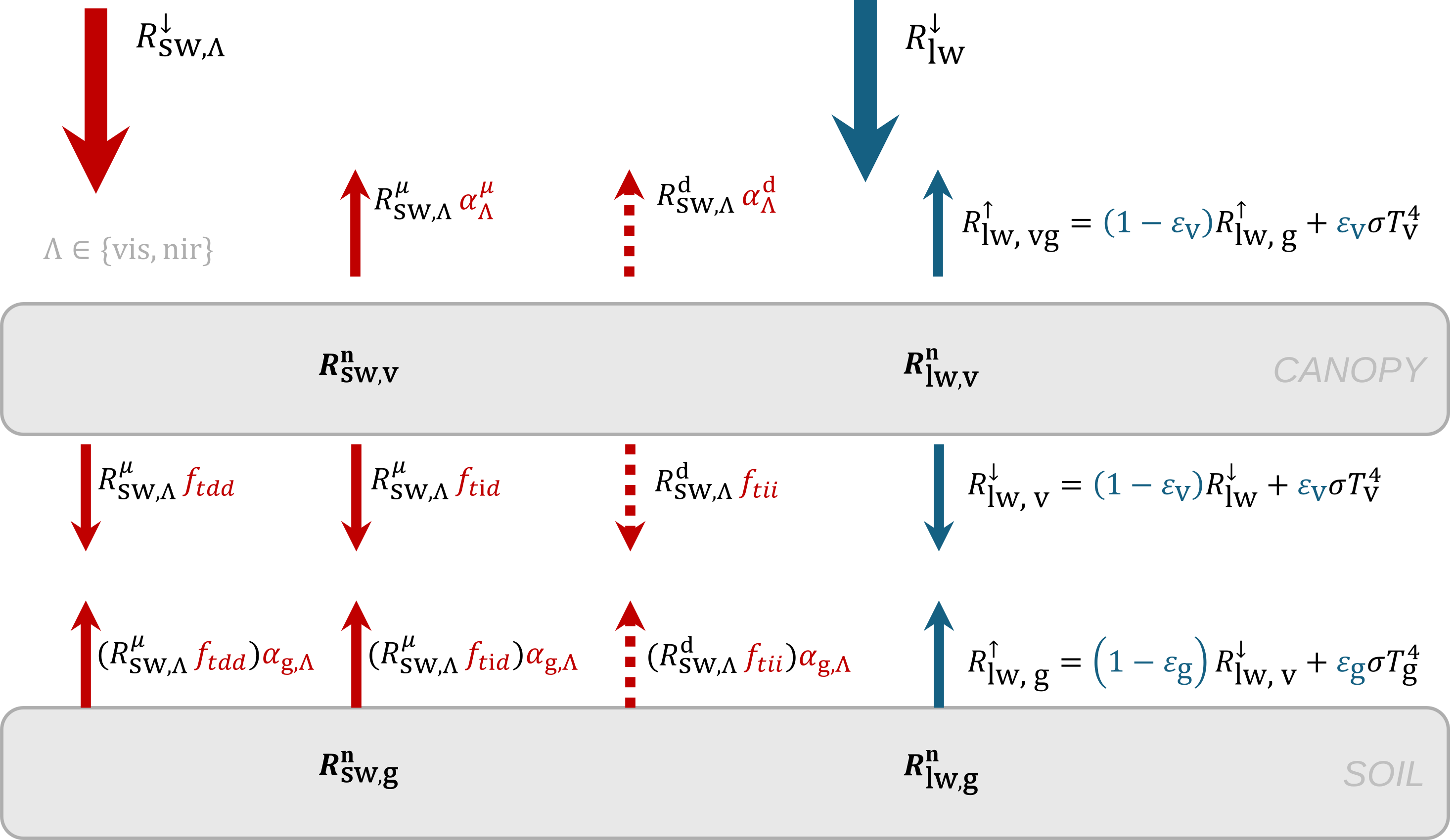
Fig. 1.2.1 Schematic diagram of shortwave (red; direct beam shown as solid lines and diffuse radiation as dashed lines) and longwave (blue) radiation absorbed, transmitted, and reflected by vegetation and the ground.
Notation
\(\Lambda \in \{\mathrm{vis}, \mathrm{nir}\}\) denotes spectral band; \(\mathrm{vis}\) corresponds to the 400–700 nm waveband, i.e. photosynthetically active radiation (PAR).
superscript \(\mu\) denotes direct-beam radiation, superscript \(\mathrm{d}\) denotes diffuse
subscript \(\mathrm{v}\) denotes vegetation, \(\mathrm{g}\) denotes ground/soil, \(\mathrm{can}\) denotes canopy
superscript \(\mathrm{n}\) denotes net (absorbed) radiation
superscripts \(\uparrow\) and \(\downarrow\) denote upward and downward directions
Coupling to other components
Optical Properties provides
canopy_single_scattering_albedo_{vis,nir},canopy_direct_beam_upscatter_parameter_{vis,nir},canopy_diffuse_upscatter_parameter_{vis,nir},canopy_direct_beam_extinction_coefficient,canopy_diffuse_optical_depth_scale, andground_{direct_beam,diffuse}_albedo_{vis,nir}.Stomatal Conductance uses
incoming_par_Wm2.Gross Primary Productivity uses
leaf_apar_Wm2.Potential Evapotranspiration uses
canopy_net_swrad_Wm2andsoil_net_swrad_Wm2.
1. Partition of incoming solar radiation
The incident shortwave flux is split into visible and near-infrared bands:
where \(f_{\mathrm{vis}}\) is vis_fraction_of_shortwave.
\(R_{\mathrm{sw},\mathrm{vis}}^\downarrow\) is the incident PAR at the canopy
top and is diagnosed as incoming_par_Wm2.
Within each band \(\Lambda\), the flux is split into direct-beam and diffuse components:
where \(f_{\mathrm{dir}}\) is direct_beam_fraction.
Throughout this page, \(\mathrm{LAI}\) denotes the one-sided leaf
area index (lai), and
denotes the total vegetation area index (vegetation_area_index),
where \(\mathrm{SAI}\) is the one-sided stem area index
(stem_area_index).
2. Two-stream radiative transfer
Governing equations
The canopy is treated as a plane-parallel medium with cumulative vegetation area index \(\tau\) measured downward from the canopy top (\(\tau = 0\)) to the ground (\(\tau = \mathrm{VAI}\)). The two-stream approximation gives coupled ODEs for the upward and downward diffuse fluxes \(I^\uparrow\) and \(I^\downarrow\) (normalized to unit incoming radiation):
The ODE coefficients are:
\(b\) is the loss rate of each stream (absorption plus backscatter into the opposite direction). \(c_1\) is the forward-scatter coupling that transfers energy from one stream to the other. \(S^\uparrow\) and \(S^\downarrow\) are the direct-beam source terms: intercepted direct radiation rescattered upward and downward, respectively, with \(\bar{\mu}\,K_{\mathrm{dir}}\) being the direct-beam optical depth per unit \(\tau\) scaled by the mean diffuse path length.
The canopy optical coefficients and geometry used here are defined in Optical Properties.
Symbol |
ADELM variables |
|---|---|
\(\omega_{\mathrm{vis}}\) |
|
\(\omega_{\mathrm{nir}}\) |
|
\(\beta_{\mathrm{vis}}^\mu\) |
|
\(\beta_{\mathrm{nir}}^\mu\) |
|
\(\beta_{\mathrm{vis}}^{\mathrm{d}}\) |
|
\(\beta_{\mathrm{nir}}^{\mathrm{d}}\) |
|
\(K_{\mathrm{dir}}\) |
|
\(\bar{\mu}\) |
|
Analytical solution
The general solution is the sum of the homogeneous solution and a particular solution driven by the direct-beam sources. The homogeneous system (\(S^\uparrow = S^\downarrow = 0\)) has exponential solutions \(e^{\pm h\tau}\) with eigenvalue:
\(h > 0\) always holds since \(b > c_1\) by construction. The two homogeneous modes represent diffuse radiation propagating downward (\(e^{+h\tau}\)) and upward (\(e^{-h\tau}\)) through the canopy. Define also \(p_1 = b + \bar{\mu}h\) and \(p_2 = b - \bar{\mu}h\), which appear in the boundary-value solution below.
The particular solution for the direct-beam forcing decays as \(e^{-K_{\mathrm{dir}}\tau}\). Its amplitude involves the denominator:
which measures the separation between the direct-beam decay rate and the diffuse eigenvalue. \(\sigma\) vanishes in the degenerate case where the two rates coincide; the solver avoids this numerically.
Two boundary conditions close the system:
Top (\(\tau = 0\)): \(I^\uparrow(0) = 0\), no upward diffuse flux enters from above.
Bottom (\(\tau = \mathrm{VAI}\)): \(I^\uparrow(\mathrm{VAI}) = \alpha_{\mathrm{g},\Lambda}\,I^\downarrow(\mathrm{VAI})\), the ground reflects the downward diffuse flux upward with albedo \(\alpha_{\mathrm{g},\Lambda}\).
Symbol |
ADELM variables |
|---|---|
\(\alpha_{\mathrm{g},\mathrm{vis}}^\mu\) |
|
\(\alpha_{\mathrm{g},\mathrm{nir}}^\mu\) |
|
\(\alpha_{\mathrm{g},\mathrm{vis}}^{\mathrm{d}}\) |
|
\(\alpha_{\mathrm{g},\mathrm{nir}}^{\mathrm{d}}\) |
|
Enforcing these two conditions on the general solution gives a 2×2 linear system for the homogeneous-mode amplitudes, which is solved analytically. Two attenuation factors at the full canopy depth \(\mathrm{VAI}\) appear in the solution:
\(s_2\) (s2) is the Beer-Lambert direct-beam transmittance through the
full canopy. \(s_1\) (s1) is the attenuation of the diffuse eigenmode
over the same depth.
Direct-beam solution
The direct-beam forcing adds a particular solution that decays as \(e^{-K_{\mathrm{dir}}\tau}\). The particular-solution amplitudes at \(\tau = 0\) are:
\(h_1\) contributes to canopy reflectance; \(h_4\) contributes to ground irradiance.
Enforcing the boundary conditions on the full solution (homogeneous plus particular) yields a 2×2 linear system. Define the ground boundary terms:
The system determinants are:
The homogeneous amplitudes for \(I^\uparrow\) (\(h_2, h_3\)) and \(I^\downarrow\) (\(h_5, h_6\)) are:
The output fractions per unit incident direct radiation are:
\(f_{tdd}\) (ftdd) is the unscattered direct-beam transmittance through
the full canopy. \(f_{tid}\) (ftid) is the downward diffuse flux at the
ground generated by scattering of the direct beam within the canopy.
\(\alpha^{\mu}_{\Lambda}\) (albd) is the combined canopy-and-ground albedo
for direct radiation.
Vegetation absorption \(\bar{I}_\Lambda^\mu\) (fabd) follows from energy
conservation:
Diffuse solution
For pure diffuse forcing there is no particular solution; the general solution consists of the two homogeneous modes only. The same boundary-value structure applies with the direct-beam sources set to zero. Using the same \(u_1, u_2, d_1, d_2\) (now with \(\alpha_{\mathrm{g},\Lambda}\) for the diffuse ground albedo), the integration constants are:
\(h_7, h_8\) are the homogeneous amplitudes for \(I^\uparrow\); \(h_9, h_{10}\) for \(I^\downarrow\). The output fractions per unit incident diffuse radiation are:
\(f_{tii}\) (ftii) is the diffuse transmittance to the ground surface.
\(\alpha^{\mathrm{d}}_{\Lambda}\) (albi) is the canopy-and-ground albedo for
diffuse radiation.
Vegetation absorption \(\bar{I}_\Lambda^{\mathrm{d}}\) (fabi) follows from energy
conservation:
3. Absorbed shortwave fluxes
For each band \(\Lambda\), vegetation absorbs contributions from both the direct beam and the diffuse stream:
Summing over the two spectral bands gives canopy_net_swrad_Wm2:
The leaf APAR \(\mathrm{APAR}_{\mathrm{leaf}}\)
(leaf_apar_Wm2) scales the canopy APAR by the leaf fraction of VAI:
The ground receives three downward flux components at \(\tau = \mathrm{VAI}\): the unscattered direct beam (\(f_{tdd}\)), diffuse generated by scattering of the direct beam within the canopy (\(f_{tid}\)), and transmitted incident diffuse (\(f_{tii}\)). Each is attenuated by the ground albedo:
Summing over the two spectral bands gives soil_net_swrad_Wm2:
The total shortwave absorbed by the land surface, net_swrad_Wm2, is: